Showing posts with label Famous Faces. Show all posts

Sunday, August 21, 2011

Shree Narayana Guru


1856 - 1928


August 1856 when a child was born in a humble cottage in the pretty hamlet of Chempazhanthi near Trivandrum, no one knew it marked the dawn of the most remarkable epoch in the social evolution of Kerala. This child was to blossom forth as the great sage Sree Narayana, the most revolutionary social reformer Kerala has produced. To have proper appreciation of the magnitude of Sree Narayana’s achievements, it is necessary to understand the background of the social conditions in which he was born and brought up. Kerala, reputed for its natural beauty and richness of life, was alas, the accursed land of caste tyranny at that time; to such an extent that it was really a "lunatic asylum" as Swami Vivekananda branded it. 

Numerically Ezhavas or Thiyyas are the largest non-caste Hindu community in Kerala. Sree Narayana was born into a middle family of this community. His parents, ‘Madan Asan’ and ‘Kutty Amma’ endearingly called him ‘Nanu’. At the age of five, he began his education in the neighboring school in the old "Gurukula" model. After his elementary education in this school, he became the disciple of a great Sanskrit scholar ‘Raman Pillai Asan’ of Puthuppally in Central Travancore. Under his master’s tutelage, he became well versed in Sanskrit classics. For some time he too functioned as an ‘Asan’, a teacher of infant pupils. Thus he came to be known as ‘Nanu Asan’. Nanu, even from his boyhood had an ascetic bent of mind. When he was on the threshold of his youth, he had to undergo the ceremonial of a marriage due to parental pressure. But he never led a married life. Sree Narayana’s mind was always agitated by a spiritual urge that induced him along with a fellow-spiritualist renowned as ‘Chattampi Swami’, to become the disciple of a man named Ayyavu, the then Superintendent of the British Residency in Trivandrum from whom he learned Yoga.

At the age of twenty-three he left his family, renounced the pleasures of his world and wandered about as an "avadhutha" or mendicant, keeping his body and soul together by the alms he received from all sorts of people. Soon he went into seclusion and immersed himself in meditation, absolutely isolating himself from contact with the human world. The caves of "Maruthwamala" and "Aruvippuram" hills in South Travancore were his abode during this period. 

Soon human eyes detected the "Sanyasin" and devotees began to gather around him at Aruvippurm, the seat of his meditation. They participated in his prayers and spiritual learning. In due course the sage emerged from his retreat and like Buddha, came out to shed light onto a world of darkness. Thus began his crusade to re-spiritualise the degraded society and fight against social inequality.

In those days, the foundation and consecration of a Hindu temple was the exclusive monopoly of Brahmins. Sree Narayana’s first revolutionary act was the consecration of temples. The first in this line was the temple dedicated to Shiva in Aruvippuram in 1888 A.D. 

The people of the Ezhava community were the first to be awakened by the teachings of Sree Narayana and to be inspired into a spirit of mass militancy to eradicate their social disabilities. This was partly because the great Guru was born in that community and partly because the Ezhavas constituted the largest single community among the downtrodden masses in Kerala. Thanks to Sree Narayana, the Ezhavas came to have their own Hindu temples whereas they were previously denied even entry. Shree Narayana Guru also ensured that his own community, the Ezhavas themselves did not discriminate against others. It should be noted that it was not only "high castes" that discriminated against "low" but various low castes treated each other extremely badly as well. Shree Narayana Guru stopped this totally. Within a few years Sree Narayana established a multitude of temples all over Kerala.

It is significant that the history of founding of Temples by Sree Narayana was a process of evolution through which he slowly prepared the minds of the masses in the progressive realization of more and more revolutionary ideas. First he founded the temples dedicated to Shiva in the caste-Hindu pattern. Then in 1912 he made a temple dedicated to ‘Sharada’, the goddess of learning was founded at Varkala, thereby including the ideal of the worship of knowledge. Revolutionary changes were also introduced in the traditional rituals and ceremonials to be observed in temples. The next milestone in the path of his reform was the foundation of a temple in Murikkumpuzha near Trivandrum in 1922, where, in the place of a deity a bright light revealing the words "Truth, Duty, Kindness, Love" was installed. The climax of his temple reform was the installation of a mirror for worship in the temple founded at Kalavancode in Sherthallai. The mirror is symbolic of Sree Narayana’s teachings that man should find his salvation not in lifeless deities but in himself by the development and utilization of his inner self (atman) which is tremendously powerful and always pure and blissful. We have a portion of the Eternal Being within us, and we should learn to worship it in ourselves and others, and surrender to it. With such thoughts and practice, who can keep us down?

Sree Narayana was a true "rishi" who lived with the people and for the people. He knew that without providing material comforts, it is futile to hold out the illusion of spiritual happiness to the starving and suffering millions. So he conducted a veritable campaign to eradicate the material disabilities of the downtrodden sections of Hindus. In 1903, Dr. P. Palpu, a devotee of Sree Narayana, founded a social organization called S.N.D.P Yogam (Sree Narayana Dharma Paripalana Yogam), the organization to promote the Dharma of Sree Narayana. This organization has done invaluable service in the epic struggle against caste system in Kerala. The organizers of S.N.D.P made Sree Narayana as its first President. The first General Secretary of S.N.D.P Yogam was Kumaran Asan, the peerless pioneer among modern Malayalam poets. He was one of the dedicated disciples of Sree Narayana. In fact the spiritual philosophy and the crusade against caste that illumine Kumaran Asan’s poetry were inspired mainly by association with and inspiration from the great Guru. 

Sree Narayana never went about preaching. He was essentially a ‘Karma Yogi’, who served God and practised spirituality through works. But his ‘silence eloquent’, the inner light that emanated from his resplendent personality, inspired and enlightened all around him, wherever he went. Wherever he went, he earned disciples and devotees in large numbers. In 1928 he founded the "Dharma Sangha", an order of Sanyasins who were expected to be his true disciples. The members of this order were to propagate and perpetuate the teachings of Guru. 

Early in 1921 an All Kerala Fraternity Conference was held at Alwaye, and in this conference was delivered his eternal message "One Caste, One Religion, One God for Mankind". Sree Narayana founded two famous Ashrams, one at Varkala and the other at Alwaye, with educational institutions attached to them. These Ashrams remain the centers of purity and universal fraternity, the ideals, which the Guru greatly cherished and nourished. Sree Narayana did not attempt to found a new religion, but he propounded a great creed, the creed of "Universal Goodness". 

Like the great Shankaracharya (who was also from Kerala), Sree Narayana was a profound thinker, a great seer and a born poet. He was also a great scholar in Sanskrit and Tamil. He has been the author of many works in Malayalam and Sanskrit, particularlu well known of which are "Atmopadesa Sathakam" and "Darsanamala" which epitomize his great moral and spiritual precepts. He has also beautifully translated Tamil works like "Thirukkural" and "Ozhuvilotukkam" into Malayalam. In his works he has superbly expounded the ‘Advaita’ (non-dualistic) philosophy. 'Daiva Dasakam' a simple prayer written by Guru. Sree Narayana greatness was recognized even while they were alive. No better testimony is needed for this than the fact that Rabindranath Tagore (the poet who wrote what is today India’s National Anthem) and Mahatma Gandhi had visited and paid respects to him. Tagore, when he visited Kerala in 1922, interviewed the Guru and was deeply impressed that he remarked-


"Among the ‘Paramahamsas’ alive in India now, there is none who has lived such a life of purity as Swami Sree Narayana". 

The great Narayana Guru attained Samadhi on September 20, 1928. Thus physically Guru disappeared, but spiritually he lives forever in the minds of millions.

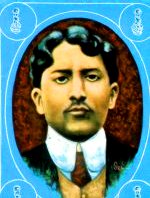
Madanlal Dhingra


(1887-1909)


"I believe that a nation held down by foreign bayonets is in a perpetual state of war. Since open battle is rendered impossible to a disarmed race, I attacked by surprise. Since guns were denied to me I drew forth my pistol and fired. Poor in health and intellect, a son like myself has nothing to offer the mother but his own blood. And so I have sacrificed the same on her altar. The only lesson required in India at present is to learn how to die, and the only way to teach it is by dying ourselves."
Extract from speech in court, July 23rd 1909


---------------------------------------------------------------
Madanlal Dhingra was born in the holy city of Amritsar, the son of a well respected doctor, who was very loyal to the British. After some time as a civil servant, Dhingra went to England, to study engineering, in June 1906. In England, Dhingra enjoyed the "good life." He used to wear expensive clothes and fragrances, spend ages on his appearance and made many English friends and was very socially active. He was a charmer, but always loved his religion and Motherland as we are about to see.


There was a house in London that was known as India House, on Cromwell Street. This was set up by Shyamji Krishna Verma. The struggle for India’s freedom was under way, and at India house resided one of its great heroes, Veer Savarkar. He used to gather many Indian students, and give speeches and hold discussions to inspire them to serve the cause of the upliftment of India. Savarkar was a skilful orator and many heeded his message. Madanlal heard of India House and decided to pay it a visit. There he heard Savarkar speak, and as he listened, his blood began to boil. Strong feelings of anger and were aroused within him which were difficult for him to control. He became a great friend and devotee of Veer Savarkar, and took the oath of the Abhinava Bharat (meaning "Young India") revolutionary society founded by him.


A few incidents show Madanlal’s endurance and fiery patriotism. Savarkar organised a day in commemoration of the anniversary of India’s 1st war of Independence in 1857 (which the British dubbed as the "Indian Mutiny"). Hundreds of Indian youth went about for the day with a badge titled "1857 - Commemoration," to the annoyance of many English. An English friend of Dhingra tried to grab the badge of him. Dhingra slapped him, punched him to the ground drew a knife, saying "Don’t dare touch the symbol of my country’s honour." The Englishman apologised and fled. One day, at India House, a group was speaking of the bravery and prowess of the Japanese (who had just defeated Russia in a war), speaking of them as the pride of Asia. After a while, Dhingra got angry. "Enough of the praise of the Japanese, do you suppose we Hindus are in any way inferior to them?" In the eyes of many Dhingra was just a pretty boy and joker. Many of those present burst out laughing at his words, and taunted him. Dhingra was infuriated. This escalated, and led to a disturbing challenge being proposed to test Dhingra’s fortitude. Someone sugested in jest that a needle should be put through Dhingra’s hand. Dhingra absolutely insisted on the challenge, despite others now trying to discourage him. The needle was put all the way through the palm of his hand. Blood flowed, those present cringed, but Dhingra just smiled. The secret society started by Savarkar (Abhinava Bharat), were making bombs and procuring arms to send to India. In one bomb making session, the concentration of those present lapsed. Dhingra’s intuition and alertness prevented a serious calamity. He stopped the immanent explosion, but was burnt in the process.


Continually hearing the plight of Indians, and the increasingly oppressive measures that were being taken in the wake of the intensifying freedom movement, Dhingra was enraged, One day he appeared before Savarkar, saying he wanted to sacrifice himself, and asked if the time was right. Savarkar replied that it was nobody else’s decision, but that Dhingra himself would know when the time was right. A long discussion followed, and various plans were thought out. Dhingra’s anger against British occupation of his motherland increased day after day. To top it off, Savarkar’s elder brother was imprisoned and deported to the Andamans (a famous high security prison). Dhingra was determined to make the British taste a bit of revenge. He brought a revolver and practised shooting.


Dhingra began to look for India haters within his site. There was an association in London called the National Indian Association (NIA). Lord Curzon Wyllie was an important member of its committee. He had been a secretary of State in India, perceived to have been responsible for several ills against the Indian people, and the NIA was actively de-Indianising the Indian youth who were part of it, "turning patriotic young men into immoral useless traitors." Dhingra became friends with its secretary Emma Beck and became a member of the organisation, also getting to know Lord Curzon. Dhingra chose the night of 1st of July at a party of the NIA, at Jahangir House of the Institute of Imperial Studies, to be the date of his retaliation against the British. The music session was just over when Curzon Wyllie entered the hall with his wife. Dhingra approached him, and fired 5 shots killing Curzon. Dhingra fired a 6th bullet when Cowasji Lalkaka, a Parsi gentlemen, dashed towards and grabbed Dhingra. Lalkaka also fell dead. Dhingra stated in court that he had no intention of killing Cowasji Lalkaka. The police arrived, and Dhingra willingly allowed his arrest.


Needless to say, England was rocked by the murder of Curzon Wyllie. Dhingra had written a statement, but the police snatched it and it was never again seen. However, Savarkar had a copy in anticipation of the police action. The Indian freedom fighters were overjoyed, but many Indians openly condemned him. Unfortunately these included his anglophile father and brother, who disowned him publicly. A meeting was held in Caxton Hall in London on the 5th July 1909, as a meet up of the prominent Indians who were loyalists to the British Raj, to pass a resolution in condemnation of Madanlal Dhingra’s conduct. Word of this meeting reached Dhingra’s friends, and a band of them attended the meeting. The Aga Khan, who presiding over the meeting moved to pass a resolution unanimously condemning Dhingra. Savarkar’s voice interrupted loudly from the back of the hall. "No, the resolution is not unanimous." The whole gathering was silenced. "Who is that?" shouted the Aga Khan. "It is me Savarkar, and I condemn it" was the reply. A young British man dashed forward and punched Savarkar to the floor. Savarkar was bleeding, and his glasses smashed, but he continued, "Happen what may, I oppose the resolution." Then Thirumalacharya, a fellow revolutionary thrashed the Englishmen who hit Savarkar, forcing him to flee. The Abhinava Bharat would suffer no insult to their beloved Dhingra.


The court case, which followed, was held at the Old Bailey Court on July 23rd. The outcome was a foregone conclusion. But it was perhaps here that was Dhingra’s finest hour. He faced the ordeal calmly and gave a voice to the suffering of his beloved Mother India. Part of his statement (delivered on July the 10th) read as follows:


"I do not want to say anything in defence of myself but simply to prove the justification of my deed. As for myself I do not think any English law court has any authority to convict me or detain me in prison or to pass any sentence against me... I hold the English responsible for the murder of 8 million of my countrymen in the last 50 years."


Up to the date of his execution, many friends came to visit Dhingra. His only formal request was very simple - that his funeral should be done in the traditional Hindu manner. Savarkar was determined to do something for Dhingra. He activated his contacts in several countries. There were indeed several non-Indians, even Britishers, who believed in India’s freedom. Dhingra’s statement was sent to major newspapers across the world, all of who published it! This was a very key event in giving momentum to the freedom movement, as many foreign voices now raised their voices in India’s favour. Dhingra certainly didn’t die in vain. In Ireland and Egypt (which were both involved in a struggle against the British), Dhingra was a hero. Annie Besant rightly said of Dhingra "More Madanlal’s are the need of the time." Later on, Madanlal Dhingra’s deeds would inspire the great martyrs Bhagat Singh and Uddham Singh.


On the day of Dhingra’s martyrdom, he had the names of Ram and Krishna on his lips. His friends printed a handout and gave it out on the streets, praising Dhingra’s sacrifice and the injustices being perpetrated against India, together with a warning that the struggle will not subside. Dhingra died with the Bhagwad Geeta in his hands. His parting words were:


"My only prayer to God is that I may be re-born of the same mother and I may die in the same sacred cause till the Cause is successful. Vande Mataram!"

Ramana Maharshi


(1879-1950)


His Significance

Ramana Maharshi is universally looked upon as one of the greatest self realised sages of modern times. He lived a quiet life with no interest in publicity, yet seekers flocked to him and today many centres bearing his name exist all over the world. He was renowned for his saintly life, for the fullness of his self-realization, and for the feelings of deep peace that visitors experienced in his presence. So many people came to see him at the holy hill of Arunchala where he spent his adult life that an ashram had to be built around him. He answered questions for hours every day, but never considered himself to be anyone's guru. 

Early Life

Ramana was born on 30 December 1879 in a village called Tirucculi about 30 miles south of Madurai in Tamil Nadu, India. His middle-class parents named him Venkataraman. His father died when he was twelve, and he went to live with his uncle in Madurai, where he attended American Mission High School. At age 16, he heard somebody mention "Arunachala." Although he didn't know what the word meant (it's the name of a holy hill associated with the god Shiva) he became greatly excited. At about the same time he came across a copy of Sekkilar's Periyapuranam, a book that describes the lives of Shaivite saints, and became fascinated by it. In the middle of 1896, at age 16, he was suddenly overcome by the feeling that he was about to die. He lay down on the floor, made his body stiff, and held his breath. "My body is dead now," he said to himself, "but I am still alive." In a flood of spiritual awareness he realized he was spirit, not his body.

His Guru 

Ramana Maharshi didn't have a human guru (other than himself). He often said that his guru was Arunachala, a holy mountain in South India.

His Teachings 

Ramana Maharshi taught a method called self-inquiry in which the seeker focuses continuous attention on the I-thought in order to find its source. In the beginning this requires effort, but eventually something deeper than the ego takes over and the mind dissolves in the heart center. The seeker then experiences the truth off their being beyond the body, and beyond time and space. The goal of realisation of the divine within us and to merge back into the sea of consciousness where there is only pure bliss and awareness is the main ultimate goal of all paths within Hinduism. Ramana Maharshi taught one of the most structured and direct paths to it. He included the aids of worship of deities, Vedic chanting, reverence for the divinty in nature, action performed surrendered fully to God all as part of the progression to pure realisation.

Ganapati Muni


1878-1938


Ganapati Muni was perhaps the chief disciple of Ramana Maharshi. Ganapati had first discovered Ramana as a young boy then realising his spiritual mastery, made Ramana his guru. Although Ganpati had studied the Vedanta (Upanishads), he had not clearly understood what tapasya meant. The simple explanation that Ramana gave cleared a big doubt that tormented him. Ganapathi Muni was the one to first call him Ramana and Maharshi. Ganapati wrote several important Sanskrit works on the Maharshi and also put Ramana’s teachings into Sanskrit.

Ganapati was a Vedic scholar, a Tantric yogi, an Ayurvedic doctor and a Vedic astrologer, as well as an active social thinker and reformer. He even researched the history of the Vedas and the Mahabharata. He was probably the greatest Sanskrit poet and writer of this century. His greatest work, Uma Sahasram, has a thousand verses and forty chapters each down flawlessly in a different Sanskrit meter. He preserved some of the deepest spiritual secrets at the heart of Hinduism and was like an ancient sage of the Vedic era. His intense sadhana (spiritual seeking/efforts) led him to evolve many paranormal abilities, which culminated in a very rare spiritual experience of "skull cracking", in which his skull cracked during his meditation and an visible light surrounded his head from then onwards. Henceforth Ganpati Muni resided in a higher state of consciousness in contact with the spiritual energies and beings of the subtle plane of existence.

In the modern era, David Frawley (Vamadeva Shastri), one of the most important figures in the Hindu world, has taken inspiration from several of Ganpati Muni's works. Therefore Ganpati's Muni's legacy continues to inspire many minds towards an integral Hindu renaissance.

Ramakrishna Paramhansa


(1826-1886)


Ramakrishna Parmahamsa is perhaps the best known saint of nineteenth century India. Depite not having the least bit of interest in publicity, people flocked to him hearing that a great saint who has experienced the Divine directly resides in Dakshineshwar. His lucid direct experience of God had a universal appeal, and even the modern Hindus educated in British schools were drawn back into their culture hearing him speak. Sri AUrobindo, another great yogi of Bengal later said: "India became free on the day when arrogant youth who had been to British schools bowed down humbly before the illiterate saint, knowing that he carried within him a greater power." 

He was born in a poor Brahman family in 1836, in a small town near Calcutta, West Bengal. As a young man, he was artistic and a popular storyteller and actor. 

Young Ramakrishna was prone to experiences of spiritual reverie and temporary loss of consciousness. His early spiritual experiences included going into a state of rapture while watching the flight of a cranes, and loosing consciousness of the outer world while playing the role of the god Shiva in a school play. 

Ramakrishna had little interest in school or practical things of the world. In 1866, he became a priest at a recently dedicated temple to the Goddess Kali located near Calcutta on the Ganges River. It was built by a pious widow, Rani Rasmani. Ramakrishna became a full-time devotee to the goddess spending increasing amounts of time giving offerings and meditating on her. He meditated in a sacred grove of five trees on the edge of the temple grounds seeking a vision of the goddess Kali. 

At one point he became frustrated, feeling he could not live any longer without seeing Kali. He demanded that the goddess appear to him. He threatened to take his own life with a ritual dagger (normally held in the hand of the Kali statue). At this point, he explained how the goddess appeared to him as an ocean of light: 

"When I jumped up like a madman and seized [a sword], suddenly the blessed Mother revealed herself. The buildings with their different parts, the temple, and everything vanished from my sight, leaving no trace whatsoever, and in their stead I saw a limitless, infinite, effulgent Ocean of Consciousness. As far as the eye could see, the shining billows were madly rushing at me from all sides with a terrific noise, to swallow me up. I was caught in the rush and collapsed, unconscious … within me there was a steady flow of undiluted bliss, altogether new, and I felt the presence of the Divine Mother."
About this time, an elderly holy women stayed with Ramakrishna for some time teaching him yogic and tantric meditation techniques. 

A yogin named Totapuri then became Ramakrishna's mentor. Ramakrishna adopted the role of renunciant and learned a nondualist form of Vedanta philosophy from him. In this system, God is understood to be the formless unmanifest energy that supports the cosmos. Ramakrishna experienced a deep form of trance (nirvilkalpa samadhi) under the guidance of this teacher. This state can be described as complete absorption of the soul into the divine ocean of consciousness. 

Ramakrishna did get married to a lady who is known as Sarada Devi, although it was a celibate marriage of a yogic couple. Disciples began to appear at this point in Ramakrishna's life. He embarked on a long period of teaching where he gathered a group of disciples around him. This period of his life is well documented by two sets of books written by his disciples. These references are listed below. Ramakrishna explained on different occasions that god is both formed and formless and can appear to the devotee either way. He often asked visitors whether they conceived of god as having qualities or as being beyond qualities. He then proceeded to teach the devotee according to the way he or she viewed the divine. 

The most famous of Sri Ramakrishna’s devotees was a youth who came to him as Narendra Dutt, who is better known to us as Swami Vivekananda. Swami Vivekananda went on to create a powerful ripple in the inertia that had gripped Hindus, and significantly changed the way that Hinduism was looked at by the world. He is considered the father of the Western Yoga movement.

Ramakrishna died of cancer of the throat in 1886.

Samartha Ramdas

1608-1681


Shri Samarth Ramdas was born in 1608AD in the village Jaamb, in Maharashtra on the auspicious day of Ramnavmi. His name was Narayan Suryaji Thosar. Ranubai was his mother. After he decided to devote his life to religion, he went to the village Takli near Nasik. There he practised meditation on the sacred "Gayatri Mantra" and chanted the name of Shri Ram. He continued observing the rigourous penace for twelve years and had many mystical experiences and realisations.

Gradually the same Narayan, became well-known and was called Samarth Ramdas, who is remebered as both a saint and even a hero in the memory of Hindus. At the age of twenty-four, he started a wandering life, moving in all corners of India for nearly twelve years and obtained the first hand knowledge of conditions of society. Under the inspiration of Shri Ram, he commenced his mission of upliftment of people, at the bank of the River Krishna.


Heaven On Earth 

Shri Samarth Ramdas, inspired, motivated, the disappointed, dejected, dormant people, of Maharashtra who were suffering under the tyranny of Islamic rules and had lost their self confidence, self-respect, and were in abject surrender to their degradation. He galvanised these common folk for confident action, for winning freedom, safeguarding their national interest, and working for excellence and self-actualisation. His inspiring teachings in are best exemplified by a pragmatic treatise 'Dasbodh' which was written at 'Shivthar', a place which is now considered very sacred and has extremely positive vibrations of all the intense meditation and devotion which has taken place there.

He placed before people, the ideal of Lord Shri Ram. He exhorted people to work like the great devotee Hanuman, the deity of strength, courage and devotion. He set up Hanuman temples everywhere, which can be found littered across Maharashtra. The chant which he popularised most was: "Shri Ram Jai Ram Jai Jai Ram".


During the same period, by the grace of the Divine the great hero Shivaji had arisen in Maharashtra. He had accepted guidance of Samarth Ramdas, for spiritual elevation as well as matters of state administration. This pair of Guru and disciple had once again brought alive the memories of Lord Shri Krishna and Arjun for establishment of truth and right just order. 


Shri Ramdas started living at the Fort Sajjangad, near Satara city, due to the love and affection of Shivaji Maharaj. He taught intense devotion and meditation, but blended it sublimely with teachings for worldly transformation and prowess. He encouraged exercise almost as much as religion. Ultimately, one day in 1681 his physical body, was merged in the cosmos. His samadhi at Sajjangad, inspires devotees for self elevation and supreme excellence in every segment of life.

TUKARAM


Tukaram is one of the great mystic saints of medieval Maharashtra, whose compositions are still recited with devotion today, and provide a source of light in the journey of many souls. He was born in 1608 in the village of Dehu on the banks of the river Indrayani into a so called low-caste Sudra family (negative propaganda has overlooked the fact that many of Hinduism’s most universally reverred saints have arisen from all castes including the lowest. It is not commonly realized that Tukaram’s family were landowners, and that they made their living by selling the produce of the land. Tukaram’s father had inherited the position of mahajan, or collector of revenue from traders, from his father, and Tukaram in turn was the mahajan of his village Dehu.

At a relatively young age, owing to the death of his parents, Tukaram took charge of the family, and before he was twenty-one years old Tukaram had fathered six children. The devastating famine of 1629 carried away Tukaram’s first wife and some of his children, and Tukaram henceforth lost interest in the life of the householder. Though he did not quite forsake his family, he was unable to maintain his second wife or children, and was ultimately reduced to penury and bankruptcy, besides being stripped by the village of his position as mahajan.

In the meantime, Tukaram turned to poetic compositions [abhangs], inspired by his devotion for Lord Vithoba [Vitthal], the family deity. He is said to have been visited in a dream by Namdeo, a great poet-saint of the thirteenth century, and Lord Vitthal himself, and apparently was informed that it was his mission to compose abhangs to spread devotion amongst the people. His compositions were in Marathi rather than Sanskrit, which meant that the teachings could more easily percolate through the masses. Some of the orthodoxy hated him for this and indeed tried to make his life difficult.

According to legend, some local Brahmins compelled him to throw the manuscripts of his poems into the river Indrayani, and taunted him with the observation that if he were a true devotee of God, the manuscripts would reappear. It is said that Tukaram then commenced a fast-unto-death, invoking the name of God; and after thirteen days of his fast, the manuscripts of Tukaram’s poems reappeared. Some of his detractors turned into his followers; and over the course of the few remaining years of his life, Tukaram even acquired a reputation as a saint. In 1649, Tukaram disappeared: his most devout followers believed that Vitthal himself carried Tukaram away, while some others were inclined to the view that he had been assassinated, though no one has ever offered an iota of evidence to justify the latter interpretation.

It is uncertain how many poems Tukaram composed, but the standard and most frequently used Marathi edition of his poetry, which first appeared in 1873 from the Indu Prakash Press with funding by the Bombay Government, and has often been reprinted, brings together 4,607 poems. Several manuscripts in Marathi exist of his poems, but some poems are found in only one manuscript version; often poems found in several manuscripts show variations; and there is no single mansucript in Tukaram’s own handwriting with all the poems that are attributed to him.

Though Tukaram’s place in the history of the development of Marathi is deemed to be inestimable, and he has been credited with being the single most influential figure in the history of Marathi literature, the body of scholarship on Tukaram outside Marathi is rather small, and translations of his work are woefully inadequate. The only nearly complete translation of Tukaram into English, entitled The Collected Tukaram, was attempted by J. Nelson Fraser and K. B. Marathe, and published in Madras by the Christian Literature Society (1909-1915). A more recent translation of a selection of Tukaram’s poetry by Dilip Chitre has been published as Says Tuka (Delhi: Penguin, 1991).

Sant Eknath


(1533-1599)


SANT EKNATH is one of the great rishis of Maharshtra. Starting from the life of Jnaneshwar (1275-1298), whose treatise on the Bhagavad Gita sprang new life into the religious life of the land, Maharashtra was blessed with a stream of great religious figures, who sustained the faith of the people in the religion of the land through many hardships. The religious renaissance eventually transformed the society completely, culminating in Independence from Islamic rule for most of India.

The life of Eknath acted like a bridge between his predecessors Jnaneshwar and Naamdev and his successors Tukaram and Ramdas His teachings of philosophy and practice is a synthesis of the quest for the eternal and transcendent while living within the imminent. This great saint of Maharashtra was born sometime around 1530 AD in a Brahmin family which had brought forth great teachers in the past. Eknath’s father, Suryanarayan, and mother, Rukmini died shortly after his birth, hence Eknath was brought up by his grandparents, Chakrapani and Saraswatibai.

Throughout his childhood Eknath devoted his time significantly to devotional practices.When about twelve years old, Eknath heard about a man named Janardan Swami. This great scholar lived in Devgiri renamed as Daulatabad by the Muslim rulers of the time. Eager to become his disciple, Eknath trudged all the way to Devgiri. Janardaswamy was amazed by this extra-ordinarily gifted boy and readily accepted him as his disciple. He taught Eknath Vedanta, Nyaya, Meemansa, Yoga etc. (i.e. a broad based education of Hindu dharma) and most importantly, Sant Jnaneshwar’s works.

Janardan Swami was a devotee of Lord Dattatreya, the son of Atrimuni and his wife Anasuya. Eknath soon achieved self-realisation through his dedicated practice. The Guru then asked Eknath to proceed on pilgrimage. He himself accompanied Eknath upto Nasik-Tryambakeshwar. Here, Eknath wrote his famous treatise on Chatushloki Bhagavat. Which was a treatise on the application of four sacred shlokas of the holy "Bhagavat." Eknath’s work consisted of 1036 specially metered verses known as "ovee"s. After completing his pilgrimage of various holy places of west and north India, Eknath returned to Paithan where he was born. His grandparents were extremely delighted to see him again and implored him to marry. Eknath married a lady named Girija. The couple were truly made for each other and established the ideal examples of ethical living. In time, the couple was blessed with two daughters, Godavari and Ganga and a son Hari.

During the intervening period of about 250 years between Dnyaneshwar and Eknath, various Islamic invaders ravaged Maharashtra. Defeats after defeats had completely demoralised people. The great legacy of Jnaneshwar was nearly forgotten. Eknath devoted himself to change this situation. His first task was to locate the "samadhi" of Jnaneshwar and trace the undistorted version of "Jnaneshwari" (Jnaneshwar’s treatise of the Bhagavad Gita). In fact, without Eknath’s all-out efforts, the legacy of Jnaneshwar could well have been lost to the succeeding generations. He also devoted him self in fighting against untouchability and other ills, which were rotting the society. 

His inspiration to fight untouchability were the teachings of Sri Krishna. Eknath’s teachings may be summarized as "Vichar, Uchchar and Achar" – i.e., purity of thought, speech and practices. Exemplifying the way of ethical and spiritual living, he practised what he preached. His works, verses and preaching kindled hope among the people at a time when they needed it most. At last following the example of the great Jnaneshwar, he left for his heavenly abode by voluntarily laying down his life in the sacred Godavari on the Krishna Shasthi day of Phalguna in the year Shaka 1521 (1599AD).

Jnanadeva


(1275-1298)


Jnanadeva of Devagri (Maharashtra) lived late in the 13th during the rule of King Ramadevarao, immediately prior to the Islamic invasions of that part of India. He lived for an all too brief 22 years and left a rich body of spiritual writings [Amritanubhava, the Abhangas, the Jnanesvari and the Changadeva Pasashti]. Biographical details are sketchy. It seems Jnanadeva lived approximately 1275 to 1296. Some scholars allege some attributed works are written by two different persons of the same name; there are two tombs [or Samadhi] in existence for Jnanadeva, which further confuses historical data. Jnanadeva translated the Bhagavad Gita into Marathi and provided a magnificent commentary that is richly illustrated with idiom, metaphor, simile and homely example. His principal work, the Jnanesvari was named Bhavartha Deepika (Light on the Inner Meaning); however it goes by the name "the Jnanesvari" in honour of his name, Jnanadeva. His works charged the entire region of Maharashtra with devotion and wisdom.

Jnanadeva inspired other saints that followed him - Namadeva, the tailor's son, Narahari, the goldsmith, Gora the potter, Chokamela and his wife, who were from a very low caste and Janabai, the maid servant, and so on. He was the pioneer of the Abhanga tradition, and of the Varkari tradition, the annual pilgrimage to the sacred Vittal Mandir of Pandaripur. In the ceturies which proceeded his life, the seed which he created blossomed and many other great seers and upholders of Hinduism in that land came forth, such Eknath, Tukaram and Ramdas. It is not inaccurate to say that the great political renaissance of Hinduism that occurred in Maharasthra which was the first reggion to decimate the Moghuls owes much to the renewed faith in people's hearts that was imparted by Jnanadeva, some centuries earlier.

Jnanadeva voluntarily left his body for union with the Divine in Alandi, near Poona in 1296 at the age of 22 (25 by some other scholars). He had done what he had come to do in his birth. He took his last bath, and descended the steps into the Samadhi that had been prepared for him. Sitting in the padma position and facing North, he voluntarily released his mortal coil.